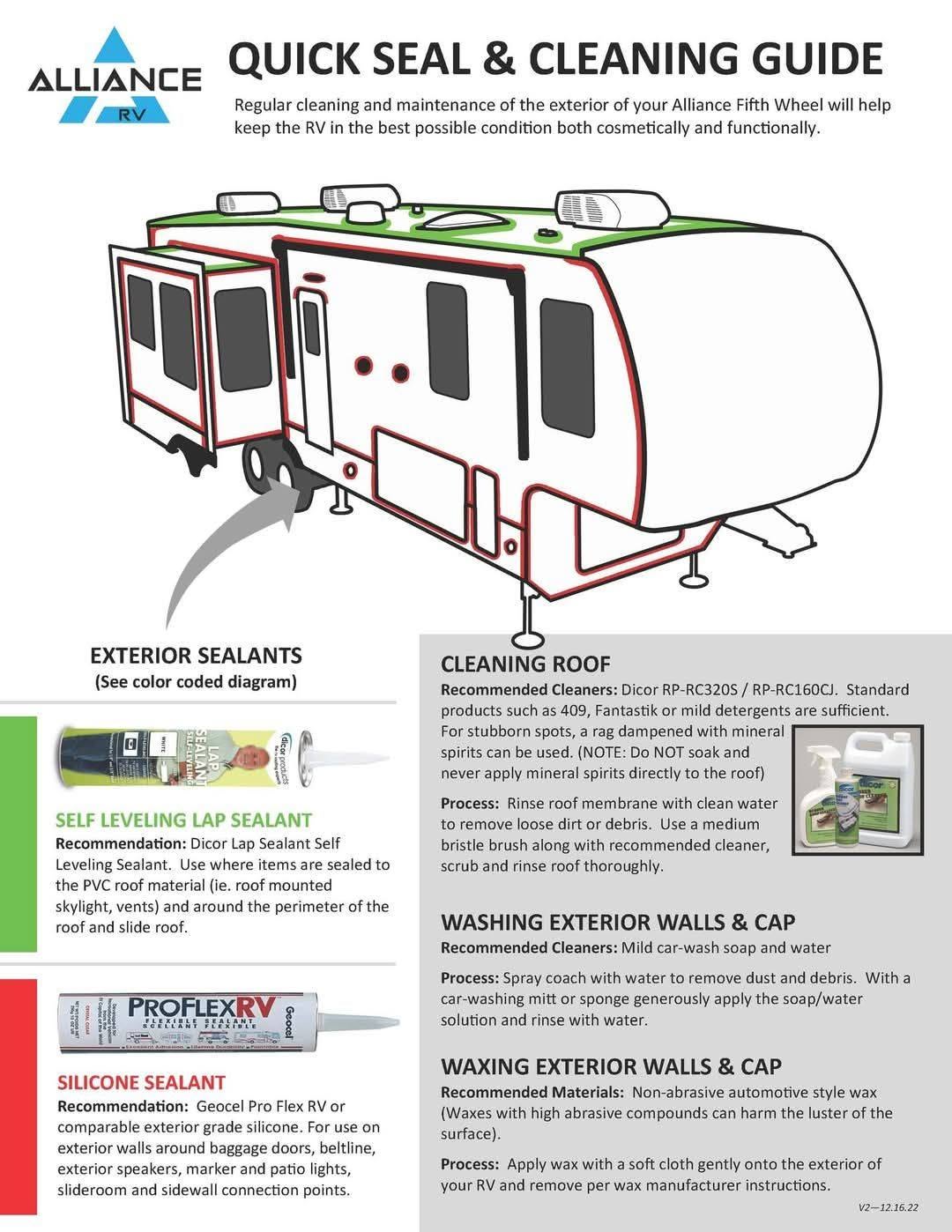
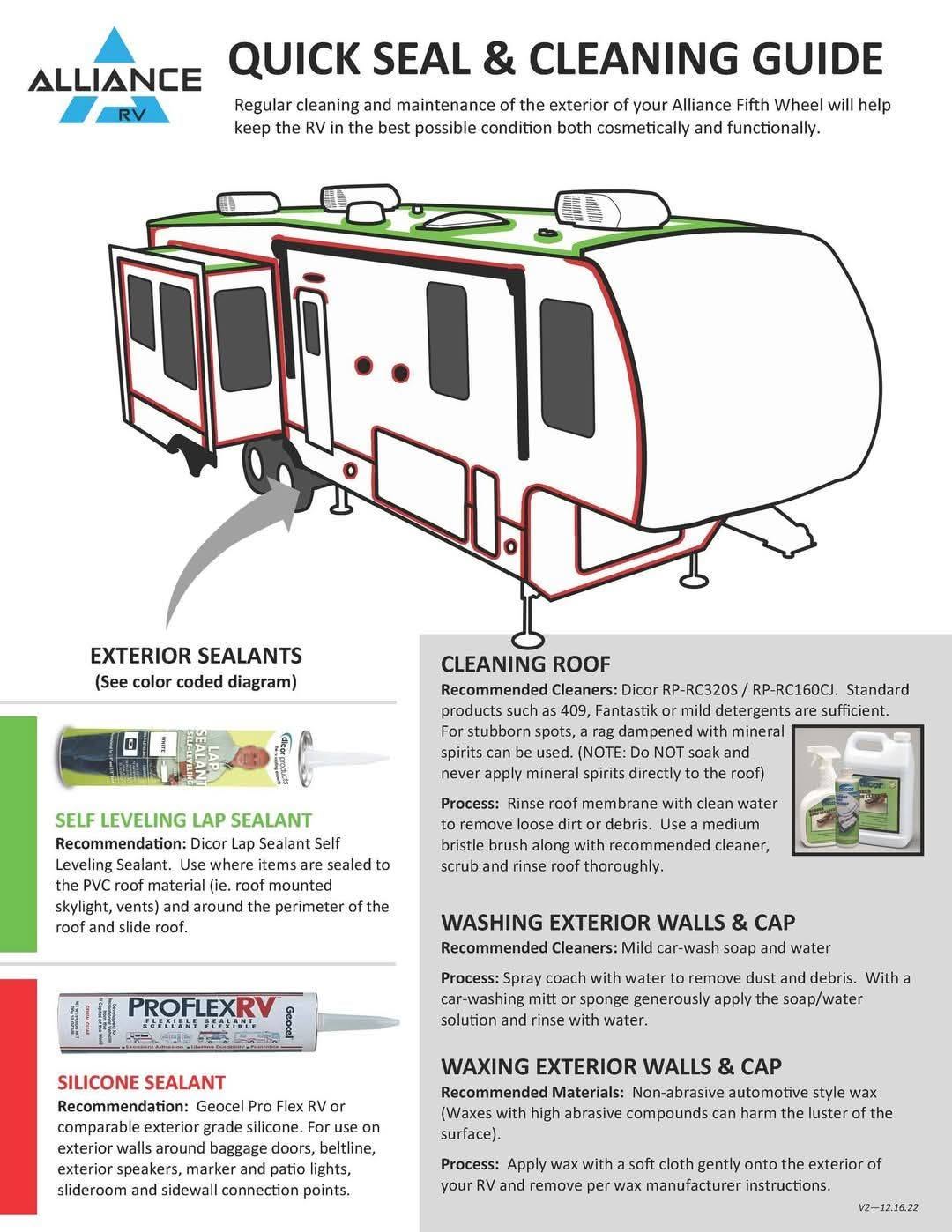
Choosing the right sealant helps keep your Alliance RV sealed against water intrusion. Alliance’s Quick Seal & Cleaning Guide uses a color-coded diagram to show which products to use in different areas:
- Green — Roof and slide roof: Alliance recommends Dicor self-leveling lap sealant where components meet the PVC roof membrane, including skylights, vents, and the perimeter of the roof and slide roof.
- Red — Exterior walls and connection points: Alliance recommends Geocel Pro Flex RV around baggage doors, beltline trim, exterior speakers, marker and patio lights, and slide-room and sidewall connection points.
Use the chart as a reference when inspecting or touching up exterior seals. Before applying a product, confirm compatibility with your rig’s roof or exterior materials and follow the sealant manufacturer’s preparation and application instructions.
How to apply sealant
- Pick a dry day above 50°F. Most sealants need a few hours without rain to skin over and a day or more to cure.
- Remove loose and cracked sealant. Use a plastic scraper on the roof so you don't cut the PVC membrane. You don't need to remove sealant that's still well bonded; new Dicor bonds to old Dicor.
- Clean the area. Wash off dirt, then wipe with denatured alcohol on a clean rag and let it dry. Avoid mineral spirits and other solvents on the roof membrane.
- Use the right product for the spot. Dicor self-leveling on horizontal roof surfaces only. Geocel Pro Flex or Dicor non-sag on walls and anything vertical; self-leveling will run down a wall.
- Lay a continuous bead. Cut the tube tip small, hold the gun at a steady angle, and push the bead ahead of the tip. On the roof, cover the fastener heads and the edge of the fixture by about 1/2" on all sides.
- Tool wall seams once. Smooth Geocel with a gloved finger or tool within a few minutes. Leave self-leveling Dicor alone; it flattens itself.
- Check it the next day. Look for pinholes, gaps or spots where the bead pulled away, and touch them up.
Inspecting and maintaining seals
Alliance recommends inspecting the roof and all sealant at least twice a year, and after any hailstorm or brush with a branch. Spring and fall work well, alongside de-winterizing and winterizing. See the 310RL maintenance schedule for everything else that's due then.
What to check
| Area | Look for |
|---|---|
| Roof fixtures | Cracks or lifting around vents, AC shrouds, skylight, antenna, solar mounts and ladder brackets |
| Roof edges and slide roofs | Gaps at the end caps and termination bars; debris holding water on slide roofs |
| Front cap and corners | Separation along the cap seam and corner molding |
| Windows, doors, lights | Cracked or missing sealant around frames, marker lights and baggage doors |
| Slide seals (wipers and bulb seals) | Tears, flattening, or seals folded under after the slide goes out |
| Inside the rig | Soft spots, stains or musty smells near ceilings and slide corners. These are early signs of a leak. |
Keeping seals in good shape
- Slide seals: inspect each time you open a slide (Alliance). Clean with a mild cleaner and treat with a rubber seal conditioner every few months. Unfold any seal that tucks under.
- Door and window gaskets: wipe with 303 Aerospace Protectant on a microfiber cloth to keep them supple.
- Roof: clean with a mild cleaner made for PVC roofs. Skip petroleum-based cleaners and harsh solvents, which damage the membrane and sealant.
- Washing: keep pressure washers under 1,200 PSI and don't aim them at seams or seals (Alliance).
- Fix small problems now. A cracked bead is a 10-minute repair; a soaked wall is a major one. Follow the steps above.